

Scheda oggetti presenti nel museo a vario titolo
Schede catalografiche di base compilate da Alessandro Grossi
Gli oggetti qui schedati sono rappresentazioni fisiche delle figure dell’immaginario o strumenti di attività lavorative della civiltà contadina legati prevalentemente alla tessitura e/o all’intrecciatura. Le statuette prevalentemente in terracotta sono il risultato di attività scolastiche con gli alunni dei Licei Artistici della provincia di Lucca e ripropongono storie e personaggi dell’immaginario folklorico.
The Museum Collections
Objects of material culture and folk imagination preserved by the Museum: search by keyword or browse by section.
166 records found.
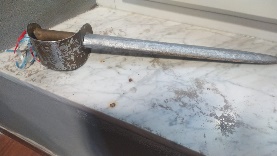
Stage sword of the Garfagnana Maggio folk drama
Maggio Folk DramaStage sword used in performances of the Garfagnana Maggio folk drama. It features a turned wooden handle, semicircular metal guard, and painted wooden blade. The tip is colored…
Read the full record
- Category
- Theatrical accessory / Folkloric object
- Provenance
- Community of Maggio performers of Garfagnana
- Materials
- Wood, metal, paint
- Technique
- Handcrafted assembly, manual painting
- Dimensions
- approx. 80 × 15 × 10 cm
- Dating
- 20th century
- Location
- Italian Museum of Folk Imagination – Maggio Folk Drama Section
- Condition
- Good; wear consistent with stage use
- Interpretation and context
- In the Maggio folk drama the sword is not a real weapon but a symbol: a tool of gesture, speech, and fate. It “cuts” the scenic space, points to sky or earth, marks the rhythm of the sung verse, and embodies heroic virtue. It bears witness to the continuity of Garfagnana’s popular theatre and its ritual language.
- Compiled by
- Alessandro Grossi
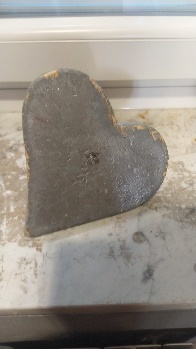
Shield of the Garfagnana Maggio folk drama
Maggio Folk DramaStage shield used in performances of the Garfagnana Maggio folk drama. Made of shaped and painted wood, it has an irregular, flowing outline with a brown surface and…
Read the full record
- Category
- Theatrical accessory / Folkloric object
- Provenance
- Community of Maggio performers of Garfagnana
- Materials
- Painted wood
- Technique
- Hand carving and painting
- Dimensions
- approx. 40 × 35 × 3 cm
- Dating
- 20th century
- Location
- Italian Museum of Folk Imagination – Maggio Folk Drama Section
- Condition
- Good; wear consistent with stage use
- Interpretation and context
- The shield, together with the sword and helmet, forms part of the symbolic armament of the Maggio folk drama. Its irregular shape and red plate evoke the tension between defense and sacrifice, between heroic gesture and popular theatricality. Simple yet expressive, the object embodies the material memory of Garfagnana’s ritual stage tradition.
- Compiled by
- Alessandro Grossi
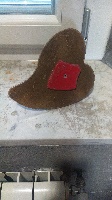
Shield of the Garfagnana Maggio folk drama
Maggio Folk DramaStage shield used in performances of the Garfagnana Maggio folk drama. Made of shaped and painted wood, it has an irregular, flowing outline with a brown surface and…
Read the full record
- Category
- Theatrical accessory / Folkloric object
- Provenance
- Community of Maggio performers of Garfagnana
- Materials
- Painted wood
- Technique
- Hand carving and painting
- Dimensions
- approx. 40 × 35 × 3 cm
- Dating
- 20th century
- Location
- Italian Museum of Folk Imagination – Maggio Folk Drama Section
- Condition
- Good; wear consistent with stage use
- Interpretation and context
- The shield, together with the sword and helmet, forms part of the symbolic armament of the Maggio folk drama. Its irregular shape and red plate evoke the tension between defense and sacrifice, between heroic gesture and popular theatricality. Simple yet expressive, the object embodies the material memory of Garfagnana’s ritual stage tradition.
- Compiled by
- Alessandro Grossi
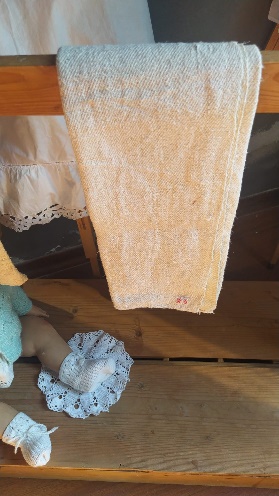
Hemp cloth
Natural hemp cloth, hand-woven with a dense and regular weave. Features embroidered red initials “R B” along the lower edge. The ivory-colored fabric shows the typical roughness and…
Read the full record
- Category
- Domestic and handcrafted textiles
- Subcategory
- Cloth / hemp fabric
- Provenance
- Antonina Bravi – originally belonging to her grandfather, early 1900s
- Materials
- Hemp
- Technique
- Hand weaving and red-thread embroidery
- Dimensions
- Length approx. 100 cm; width approx. 50 cm
- Dating
- First half of the 20th century
- Location
- Museo Italiano dell’Immaginario Folklorico
- Condition
- Good, with slight wear and natural yellowing
- Interpretation and context
- Hemp fabrics were common in Garfagnana households until the mid-20th century. Locally grown hemp was spun and woven at home, symbolizing self-sufficiency and family labor. The embroidered initials identified ownership within the household trousseau.
- Compiled by
- Alessandro Grossi
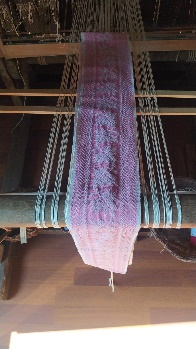
Woven baby band
Handwoven cotton and wool band featuring a stylized leaf pattern and herringbone border. Pink and white tones alternate in a regular rhythm, creating a delicate and harmonious effect.…
Read the full record
- Category
- Domestic and personal-use textiles
- Subcategory
- Baby band
- Provenance
- Garfagnana artisanal workshop
- Materials
- Dyed cotton and wool
- Technique
- Manual weaving on traditional loom
- Dating
- 20th–21st century
- Function
- Baby band or domestic layette item
- Location
- Italian Museum of Folk Imagination
- Condition
- Excellent, with intact and even weave
- Interpretation and context
- The band, intended for newborns, symbolizes care and protection. The vegetal motif evokes growth and continuity of life, while the handweaving preserves the memory of women’s hands intertwining threads and affection. A simple yet symbolic object, it connects domestic life with the rituality of the Maggio folk drama, where fabric becomes a sign of bond and rebirth.
- Compiled by
- Alessandro Grossi
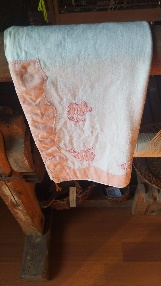
Towel with floral embroidery and border
Light-colored towel, likely cotton or linen, featuring a pink fabric border and tone-on-tone floral embroidery. The stylized flowers are arranged symmetrically and executed in satin and stem stitches;…
Read the full record
- Category
- Domestic and everyday textiles
- Subcategory
- Decorative towel
- Provenance
- Donated by Daniela Fontanini
- Materials
- Cotton or linen
- Technique
- Manual weaving, embroidery, and border application
- Dating
- Early 20th century
- Function
- Decorative or layette towel
- Location
- Museo Italiano dell’Immaginario Folklorico
- Condition
- Good, with intact weave and well-preserved colors
- Interpretation and context
- In the early 1900s, Garfagnana was a rural and mountainous region where domestic weaving and embroidery were daily activities. Women produced towels, tablecloths, and layettes often enriched with colored borders and floral motifs, symbols of care and beauty in family life. These handmade items combined utility and ornamentation, reflecting the continuity of local craft traditions.
The floral motif, embroidered in soft tones, evokes values of renewal, harmony, and domestic protection. In Garfagnana tradition, the flower symbolized good fortune and feminine grace, associated with home care and emotional continuity across generations. The pink border, color of tenderness and intimacy, enhances the familial and affectionate nature of the piece. - Compiled by
- Alessandro Grossi
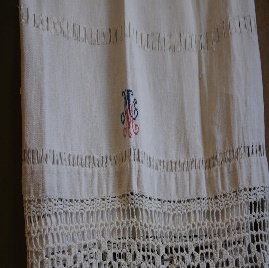
Trousseau towel with embroidered monogram “M S”
Central monogram “M S” in red and blue thread; horizontal drawn thread bands; lower edge with geometric lace
Read the full record
- Category
- Domestic textiles – trousseau linens
- Provenance
- Central or northern Italy (domestic or convent setting)
Donated by Daniela Fontanini - Materials
- White linen or cotton, fine thread
- Technique
- Plain weave loom work; hand drawn thread work; cross stitch or satin stitch embroidery; crochet lace edging
- Dimensions
- Not recorded (typically 40–60 cm × 80–100 cm)
- Dating
- Late 19th – early 20th century
- Function
- Bridal trousseau or washstand towel; decorative household linen
- Location
- Esposizione: Displayed vertically or laid flat, with raking light to enhance weave and embroidery
Museo Italiano dell’Immaginario Folklorico - Condition
- Good; slight signs of use and natural fabric yellowing
- Interpretation and context
- Example of women’s domestic embroidery and lace-making traditions; symbol of care, skill, and family identity. The monogram identifies the owner or household; drawn thread work and lace reflect manual expertise and aesthetic value.
The intertwined monogram symbolizes unity, identity, and domestic memory; red and blue evoke passion and devotion. The lace acts as a visual threshold between intimacy and display. - Bibliography
- Dalla Ragione, Household Trousseaux and Domestic Memory, Rome, 2008. — Ghidoni, Italian Embroidery and Lace, Milan, 1995.
- Compiled by
- Alessandro Grossi
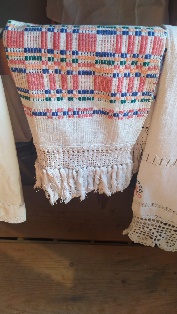
Handwoven towel with fringes and geometric pattern
Handwoven cotton towel featuring a multicolored geometric pattern in shades of red, blue, green, and orange on a white background. The lower edge includes handmade lace and twisted…
Read the full record
- Category
- Domestic and handcrafted textiles
- Subcategory
- Towel / trousseau linen
- Provenance
- Donated by Daniela Fontanini
- Materials
- Cotton
- Technique
- Hand-loom weaving and finishing with lace and fringes
- Dimensions
- Length approx. 90 cm; width approx. 45 cm
- Dating
- First half of the 20th century
- Location
- Museo Italiano dell’Immaginario Folklorico
- Condition
- Good, with slight signs of use
- Interpretation and context
- Handwoven towels were part of domestic trousseaux and were made in rural Garfagnana households. The geometric motifs and bright colors reflect women’s creativity and the continuity of local textile traditions.
- Compiled by
- Alessandro Grossi
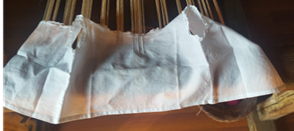
White cotton women’s bodice
White cotton women’s bodice, simple and linear in design, with hand stitching and finished edges. Sleeveless, it features a front opening with small buttons and a close-fitting shape.…
Read the full record
- Category
- Traditional clothing
- Subcategory
- Bodice / women’s undergarment
- Provenance
- Terni Family of Poggio
- Materials
- Cotton
- Technique
- Hand sewing
- Dimensions
- Height approx. 30 cm; width approx. 40 cm
- Dating
- First half of the 20th century
- Location
- Museo Italiano dell’Immaginario Folklorico
- Condition
- Good, with slight fabric wear
- Interpretation and context
- In Garfagnana, bodices of this kind were made at home or by local seamstresses, often as part of a woman’s trousseau. The garment, a symbol of modesty and personal care, reflects the rural tradition of domestic weaving and sewing, where each stitch represented a gesture of devotion and family continuity.
- Compiled by
- Alessandro Grossi
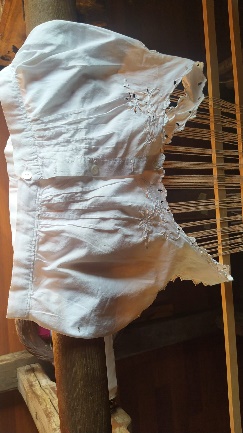
Embroidered cotton women’s bodice
Embroidered white cotton women’s bodice, simple and linear in design, with hand stitching and finished edges. Sleeveless, it features a front opening with small buttons and a close-fitting…
Read the full record
- Category
- Traditional clothing
- Subcategory
- Embroidered cotton women’s bodice
- Provenance
- Terni Family of Poggio
- Materials
- Cotton
- Technique
- Hand sewing and embroidery
- Dimensions
- Height approx. 30 cm; width approx. 40 cm
- Dating
- First half of the 20th century
- Location
- Museo Italiano dell’Immaginario Folklorico
- Condition
- Good, with slight fabric wear
- Interpretation and context
- In Garfagnana, embroidered bodices of this kind were made at home or by local seamstresses, often as part of a woman’s trousseau. A symbol of modesty and personal care, they reflect the rural tradition of domestic weaving and sewing.
- Compiled by
- Alessandro Grossi
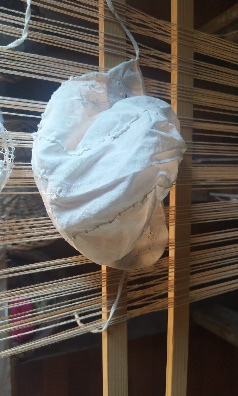
Embroidered cotton bonnet
Women’s bonnet in embroidered white cotton, with openwork and hand stitching. Rounded shape covering the head, with side ties fastening under the chin.
Read the full record
- Category
- Traditional clothing
- Subcategory
- Bonnet / women’s head covering
- Provenance
- Terni Family of Poggio
- Materials
- Cotton
- Technique
- Hand embroidery and sewing
- Dimensions
- Height approx. 20 cm; width approx. 25 cm
- Dating
- First half of the 20th century
- Location
- Museo Italiano dell’Immaginario Folklorico
- Condition
- Good
- Interpretation and context
- Embroidered cotton bonnets were common in Garfagnana households and worn during domestic work or devotional moments. A symbol of care and modesty, they reflect the women’s sewing traditions passed down in rural families.
- Compiled by
- Alessandro Grossi
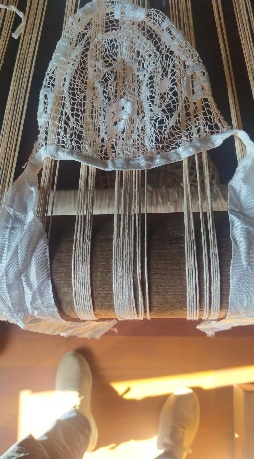
Lace and cotton bonnet
Women’s bonnet in white lace and cotton, with openwork floral motifs. Delicate and refined, used in daily or ritual contexts.
Read the full record
- Category
- Traditional clothing
- Subcategory
- Bonnet / women’s head covering
- Provenance
- Terni Family of Poggio
- Materials
- Lace, cotton
- Technique
- Lacework and hand sewing
- Dimensions
- Height approx. 20 cm; width approx. 25 cm
- Dating
- First half of the 20th century
- Location
- Museo Italiano dell’Immaginario Folklorico
- Condition
- Good
- Interpretation and context
- Lace bonnets were considered more elegant and often reserved for festive days or devotional moments. Their presence in rural households reflects the aesthetic care and artisanal skill of Garfagnana women.
- Compiled by
- Alessandro Grossi