

Scheda oggetti presenti nel museo a vario titolo
Schede catalografiche di base compilate da Alessandro Grossi
Gli oggetti qui schedati sono rappresentazioni fisiche delle figure dell’immaginario o strumenti di attività lavorative della civiltà contadina legati prevalentemente alla tessitura e/o all’intrecciatura. Le statuette prevalentemente in terracotta sono il risultato di attività scolastiche con gli alunni dei Licei Artistici della provincia di Lucca e ripropongono storie e personaggi dell’immaginario folklorico.
The Museum Collections
Objects of material culture and folk imagination preserved by the Museum: search by keyword or browse by section.
166 records found.
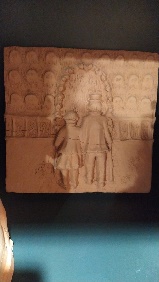
Relief “The Cemetery”
Terracotta relief depicting two figures seen from behind—a man and a woman—approaching a flower-decorated arch in a cemetery. Rows of gravestones inscribed “RIP” form the background. The piece…
Read the full record
- Provenance
- “A. Passaglia” Art High School, Lucca
“A. Passaglia” Art High School, Lucca - Materials
- Terracotta
- Technique
- Modeling and bas-relief
- Dimensions
- approx. 30 × 25 cm
- Dating
- 21st century
- Location
- Italian Museum of Folk Imagination
- Interpretation and context
- The scene portrays the transition between life and memory, with the floral arch serving as a threshold between the earthly and the spiritual realms. The figures, joined in remembrance, embody the continuity of affection beyond death. The terracotta’s warm, fragile texture enhances the sense of humanity and compassion.
- Compiled by
- Alessandro Grossi

The Violinist and the Red Figure
Gestualità e SuonoTwo rough clay figures, one appearing to play an instrument, wrapped in a red cloth. The composition suggests movement, emotion, and dialogue between matter and music.
Read the full record
- Provenance
- Anonymous contemporary artist
Collection of the Italian Museum of Imaginary Folklore - Materials
- Modeled clay, fabric
- Technique
- Hand modeling and mixed assemblage
- Dimensions
- approx. 40 × 30 × 25 cm
- Dating
- 21st century
- Location
- Section “Gesture and Sound”
Museo Italiano dell’Immaginario Folklorico - Condition
- Good; slight surface wear
- Interpretation and context
- The red fabric evokes passion and vital energy, while the figures, fused in gesture, represent the union between art and spirit.
- Compiled by
- Alessandro Grossi
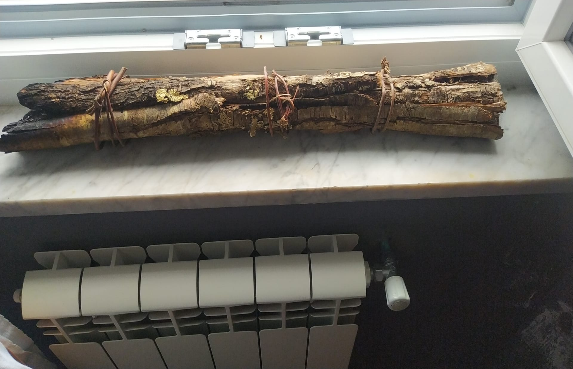
Bark Torch
Bundle of dried bark tied at three points with natural cords. Used as a torch to light domestic or outdoor spaces before the spread of electric lighting.
Read the full record
- Category
- Domestic and ritual object
- Subcategory
- Lighting tool
- Provenance
- Made, donated, and demonstrated in use by Emilio Lammari from Barga
- Materials
- Dried bark and vegetal cords
- Technique
- Manual weaving and binding; slow combustion of resinous bark
- Dating
- 19th–20th century
- Function
- Source of light for evening gatherings, work, or ceremonies; symbol of protection and purification
- Location
- Museo dell’Immaginario Folklorico
- Condition
- Good; traces of resin and natural oxidation
- Interpretation and context
- In the Garfagnana region, bark torches were common in rural homes and barns. They were lit during evening gatherings, night work, or festivities, and sometimes carried in religious processions. Fire symbolized protection, light, and community continuity.
The use of bark torches is documented throughout the Apennine area until the mid-20th century. In Garfagnana, the practice lasted longer in mountain communities thanks to the availability of chestnut and resinous pine bark.
Fire as light that protects and purifies, a bridge between the human and the sacred. - Bibliography
- Direct observation; oral testimonies from Garfagnana
- Compiled by
- Alessandro Grossi
![Creature Head [Zoomorphic Figure]](https://museoimmaginario.net/immaginario/wp-content/uploads/schede-catalogo/scheda-130-testa-di-creatura-figura-zoomorfa.jpg)
Creature Head [Zoomorphic Figure]
Sculpture depicting the head of a fantastical creature with feline and feral features. Pointed ears, an open mouth, and sharp teeth give it an aggressive, dynamic expression. The…
Read the full record
- Provenance
- “A. Passaglia” Art High School, Lucca
“A. Passaglia” Art High School, Lucca - Materials
- Plaster or white clay
- Technique
- Hand modeling and sculpting
- Dimensions
- approx. 30 cm (h); 25 cm (w); 25 cm (d)
- Dating
- 21st century
- Location
- Italian Museum of Folk Imagination
- Interpretation and context
- The piece embodies the duality between instinct and reason, between animal strength and human awareness. The smooth, pale material contrasts with the ferocity of the subject, suggesting a reflection on inner wildness and the transformation of myth into artistic form.
- Compiled by
- Alessandro Grossi
![Ram’s Head [Zoomorphic Figure]](https://museoimmaginario.net/immaginario/wp-content/uploads/schede-catalogo/scheda-131-testa-di-ariete-figura-zoomorfa.jpg)
Ram’s Head [Zoomorphic Figure]
Sculpture depicting a ram’s head with curved horns and realistic anatomical details. The modeling of the muzzle and fleece conveys strength and solemnity. The piece, with its archaic…
Read the full record
- Provenance
- “A. Passaglia” Art High School, Lucca
“A. Passaglia” Art High School, Lucca - Materials
- Terracotta or natural clay
- Technique
- Hand modeling and sculpting
- Dimensions
- approx. 35 cm (h); 20 cm (w); 25 cm (d)
- Dating
- 21st century
- Location
- Italian Museum of Folk Imagination
- Interpretation and context
- The ram symbolizes vital energy, sacrifice, and rebirth. In folk culture, it embodies the power of nature and the cyclical rhythm of the seasons. The sculpture transforms these values into a tangible form, where earthly matter becomes a sign of spiritual strength and renewal.
- Compiled by
- Alessandro Grossi
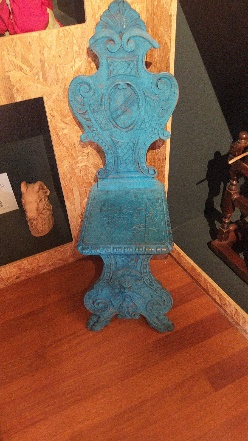
Decorative painted wooden chair
Furniture and SymbolsWooden chair painted in a vivid turquoise blue, featuring rich carved ornamentation and an elongated structure. The tall, shaped backrest displays scroll decorations and a central oval medallion,…
Read the full record
- Category
- Domestic and artistic furniture
- Subcategory
- Decorative chair
- Provenance
- Donated by Francesco Diamantini – La Spezia
- Materials
- Carved and painted wood
- Technique
- Carving and cold painting
- Dimensions
- approx. 90 × 35 × 35 cm
- Dating
- 20th century
- Location
- Italian Museum of Folk Imagination – Furniture and Symbols Section
- Condition
- Excellent, with well-preserved paint and carvings
- Interpretation and context
- Decorative chairs of this kind were often found in rural and bourgeois homes of Garfagnana and Lunigiana, where furniture also held symbolic meaning. The blue color, rare and precious, was associated with domestic protection and purity. The elaborate carving reflects local craftsmanship and the desire to turn a utilitarian object into a representative piece.
The deep blue evokes the sky and the spiritual dimension, while the sinuous shapes and central medallion suggest balance and harmony. The chair thus becomes a symbol of welcome and protection, a domestic throne uniting beauty and function. - Compiled by
- Alessandro Grossi
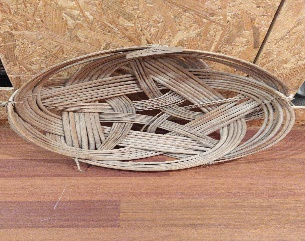
Basket
Circular basket with flat base and high sides, made with a dense and uniform weave. The structure ensures both strength and lightness.
Read the full record
- Category
- Domestic and agricultural basket
- Provenance
- Garfagnana area, Province of Lucca. Traditionally used in local agricultural activities, especially for gathering chestnuts, leaves, and small woodland products. Donated by Elena Giusti to the Gastone Venturelli Library for the 1970 exhibition “Weaving in the Lucchese Area”; later transferred and donated to the Italian Museum of Folkloric Imagination.
- Materials
- Wicker or woven wooden strips
- Technique
- Regular handwoven technique with reinforced rim
- Dating
- 20th century (first half)
- Function
- Used for collecting and carrying agricultural products, fruit, or leaves
- Location
- Museo Italiano dell’Immaginario Folklorico
- Condition
- Excellent, with minimal signs of use
- Interpretation and context
- Typical object of rural tradition, used in daily activities and symbolizing domestic economy and local craftsmanship.
- Compiled by
- Alessandro Grossi
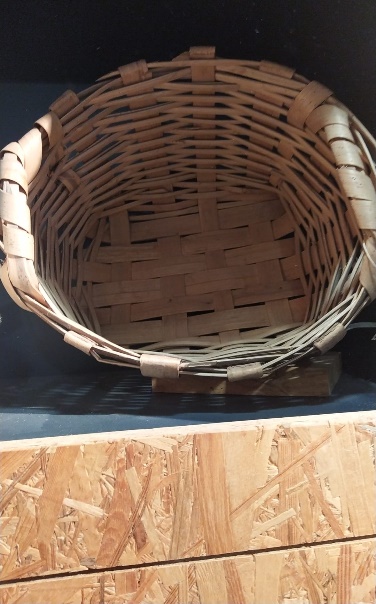
Basket
Circular basket with slightly flared sides and regular wide-strip weaving. The structure provides both lightness and stability.
Read the full record
- Category
- Domestic and agricultural basket
- Provenance
- Garfagnana area, Province of Lucca. Circular basket with regular weaving and flat base, made from local wooden strips. Traditionally used in agricultural activities for gathering leaves, fruit, and small woodland products. Donated by Elena Giusti to the Gastone Venturelli Library for the 1970 exhibition “Weaving in the Lucchese Area”; later transferred and donated to the Italian Museum of Folkloric Imagination.
- Materials
- Woven wooden strips or wicker
- Technique
- Handwoven wide-strip technique with reinforced upper rim
- Dating
- 20th century (first half)
- Function
- Used for collecting and carrying agricultural or household goods
- Location
- Museo Italiano dell’Immaginario Folklorico
- Condition
- Excellent, with minimal signs of use
- Interpretation and context
- Object of rural tradition, made with local materials and orally transmitted techniques. Symbol of domestic economy and manual labor.
- Compiled by
- Alessandro Grossi
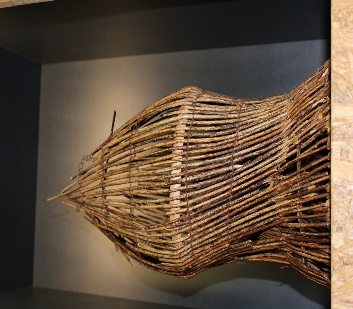
Traditional Wicker Fish Trap
Conical structure with a narrow opening preventing prey from escaping. The irregular, dense weave provides both strength and flexibility.
Read the full record
- Category
- Traditional fishing tool
Material culture – Fishing tools and river life - Provenance
- Garfagnana area, Province of Lucca. Conical-cylindrical fish trap made of flexible interwoven branches secured with vegetal bindings. Traditionally used in local waterways for catching fish and crustaceans. Donated by Elena Giusti to the Gastone Venturelli Library for the 1970 exhibition “Weaving in the Lucchese Area”; later transferred and donated to the Italian Museum of Folkloric Imagination.
- Materials
- Interwoven willow or hazel branches
- Technique
- Handwoven spiral and crossed pattern technique
- Dating
- Late 19th – mid 20th century
- Function
- Used for catching fish and crustaceans in rivers and streams
- Location
- Museo Italiano dell’Immaginario Folklorico
- Condition
- Good, with partially loosened bindings
- Interpretation and context
- Symbol of rural ingenuity and understanding of natural cycles; represents the fisherman’s patience and waiting.
- Compiled by
- Alessandro Grossi
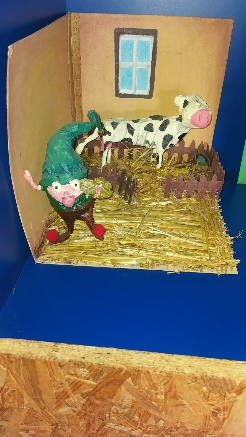
The Goblin and the Cow, papier-mâché
Diorama depicting a barn with a straw floor, a black-and-white cow, and a goblin with a green hat and red shoes. The smiling goblin appears to offer a…
Read the full record
- Category
- Narrative sculpture
- Subcategory
- Papier-mâché diorama
- Provenance
- Created by “A. Passaglia” Art High School of Lucca
- Materials
- Papier-mâché, straw, wood, acrylic paints
- Technique
- Hand modeling and painting; scenic assembly
- Dimensions
- Height approx. 25 cm; width approx. 30 cm; depth approx. 20 cm
- Dating
- 21st century
- Function
- Educational and narrative artwork inspired by Garfagnana goblin legends
- Location
- Museo dell’Immaginario Folklorico
- Condition
- Excellent
- Interpretation and context
- In Garfagnana folklore, goblins are household spirits living in barns who protect animals but also enjoy playing tricks on farmers. This depiction shows their benevolent and playful side.
Figures of goblins and rural spirits are widespread throughout northern Tuscany. Papier-mâché, a simple and versatile material, is often used in art workshops to reinterpret local myths.
The goblin represents the magical presence in rural daily life, guardian of the barn and memory of labor. - Bibliography
- Direct observation; oral testimonies from Garfagnana; art workshop of “A. Passaglia” Art High School of Lucca
- Compiled by
- Alessandro Grossi
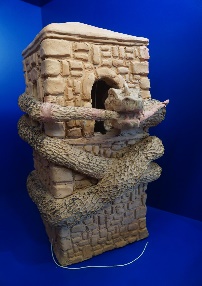
The Serpent and the Tower
Creature e Architetture del MitoSculpture depicting a stone tower entwined by a serpent. The scales and masonry texture are rendered with tactile precision, evoking the bond between architecture and nature, between protection…
Read the full record
- Provenance
- Anonymous contemporary artist
“A. Passaglia Art High School of Lucca” - Materials
- Hand-modeled and painted terracotta
- Technique
- Relief sculpture, hand modeling, incised texture
- Dimensions
- approx. 25 × 15 × 15 cm
- Dating
- 21st century
- Location
- Section “Creatures and Architectures of Myth”
Museo Italiano dell’Immaginario Folklorico - Condition
- Good; minor surface abrasions
- Interpretation and context
- The serpent, archetype of regeneration and guardianship, coils around the tower — a symbol of defense and isolation — forming an image of tension between life and stone, instinct and human construction.
- Compiled by
- Alessandro Grossi
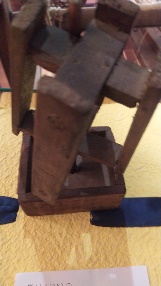
Miniature Loom Model
Small wooden model composed of interlocking vertical and horizontal elements forming a frame structure. The object reproduces, in reduced scale, the mechanical principle of the traditional loom used…
Read the full record
- Category
- Demonstrative or educational tool
- Provenance
- Garfagnana area, Province of Lucca
- Materials
- Wood
- Technique
- Manual assembly and joint construction
- Dimensions
- approx. 15 × 10 × 10 cm
- Dating
- 20th–21st century
- Function
- In Garfagnana, looms were common in rural homes until the mid-20th century for domestic production of fabrics, sheets, and clothing. Models like this were sometimes used to teach weaving or demonstrate loom mechanics during fairs and craft exhibitions.
- Location
- Italian Museum of Folk Imagination
- Interpretation and context
- The loom symbolizes creation and continuity, representing the ancient act of weaving as a metaphor for generational connection and community building. Even in miniature form, this model preserves the value of craftsmanship and memory of women’s labor.
The loom symbolizes creation and continuity, representing the ancient act of weaving as a metaphor for generational connection and community building. Even in miniature form, this model preserves the value of craftsmanship and memory of women’s labor. - Compiled by
- Alessandro Grossi